Misterioso
Forever free, I must pass madly from joy to joy

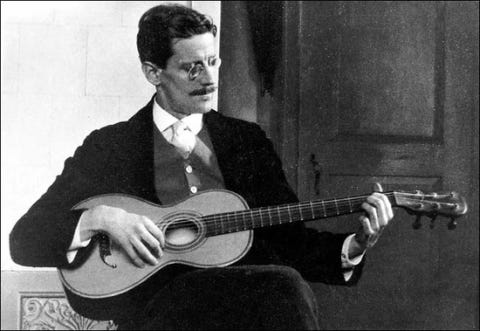
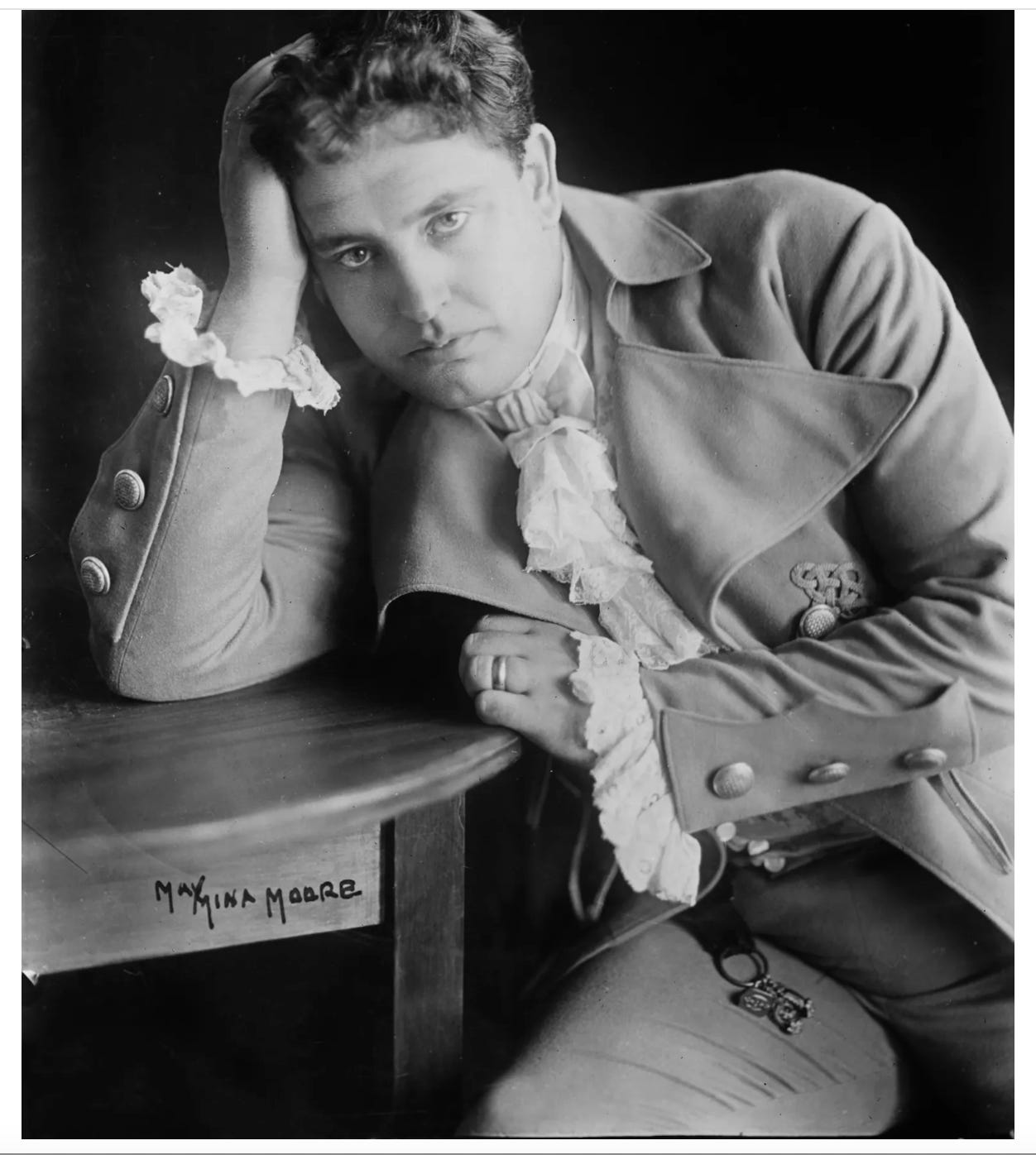
We come by our family love of opera through James Joyce, who was was a music lover and a very fine singer himself. Joyce gave up his singing ambitions after he placed a disappointing third in Feis Ceol, a prestigious Irish singing competition in 1904 when he was 22, that fateful year he set Ulysses in. His friend, the legendary Irish tenor, John McCormack had won that competition the year before and it launched him on the world stage, shortly afterward. A penniless Joyce, two years after graduating university, must have been fantasizing about a similar fate for himself when he entered the competition.
McCormack was born in Athlone, where my grandmother, Maura, was born. Her father Peter Mulvihill taught McCormack the Irish language in secret, as part of the Gaelic League. The Irish language was banned from the British controlled school system at the time and the penalty for teaching or studying it was severe. As a child, my friend the Yiddish tenor Seymour Rexite also met John McCormack. In the 1920s when Seymour was on a tour across America with the famous cantor Yosele Rosenblatt as part of the RKO Keith Vaudeville Circuit, McCormack came backstage to congratulate them both on their performance. This is all to say, that McCormack was to Irish music what Joyce was to Irish literature.
My mother’s oldest sister, Mary was a matron at Hollis Street Maternity Hospital which is the setting for The Oxen of the Sun episode of Ulysses. My first introduction to the book was meeting her after her shift when I was about 11 and having to wade through a crowd of American tourists in the midst a walking tour of all the locations mentioned in Ulysses, on our way to the theater. She thought they were mad. I was intrigued that a book I’d never read had such a devoted fandom. Mary introduced me to live theater bringing me to two or three shows a week, every time I visited. She treated me as a little adult, in need of a decent cultural education and I was her willing and grateful pupil.
Joyce’s writing is often praised for its musicality and he is best understood when read aloud. The female heart of Ulysses, Molly Bloom, is a singer and the Siren’s episode of the novel is written like a piece of music, complete with overture. There is also a famous discussion of tenors in Joyce’s short story The Dead that mentions the opera singer Enrico Caruso. I remember one night as a teenager returning home from seeing a play at the Gate to my aunt Mary’s Georgian brownstone on Marlborough Road. Inspired by that conversation in The Dead, which had recently been made into a beautiful and much watched movie by John Huston, we decided to open up a bottle of wine and hold our own singing competition, choosing once and for all who was the best tenor in history. So as she sat by the fire, smoking the Benson and Hedges, that I smuggled in through the duty free, I lay down on her Turkish rugs eating Milk Tray chocolates and drinking white wine as we played recordings of Pavarotti, Domingo, Caruso and Jussi Bjōrling all singing “Nessun Dorma (Let no one sleep)”. She liked Pavarotti, but I thought Caruso the best with Bjōrling a close second.
My father would wake up early on weekend mornings and put on an opera or some piece of classical music, loudly around 6am. None of us seemed to mind this, we were a noisy household of seven people, who could sleep through anything. La Traviata became my favorite opera, the dying courtesan bound to her bed, determined to live from pleasure to pleasure, her focus always on love and passion even as her life force ebbs way. Whenever I faced a deadline in college, in danger of having my life force ebb away, I would sit at my desk with a large bottle of Evian water and play Verdi’s La Traviata on my CD player getting through the entire opera two or three times before I finished editing. The water kept me awake and the music created a protective bubble around me so I could go deep into my mind and concentrate. I spent my junior year of college in Jerusalem and I wasn’t there a few weeks before I dislocated my knee doing cartwheels on a beach in Tel Aviv and ended up in a full leg cast. I stayed with family friends for a few days to adjust to my cast and the patriarch, Eli Okun, a pathologist and opera lover, like my own father, had a copy of La Traviata on video, so we watched it together to pass the time.
The first opera I brought my son to when he was ten was of course, La Traviata. It was my birthday and our first time visiting the Met. I purchased $30 family circle tickets at the very highest level of the theater. The high altitude made my son nervous and he did not enjoy himself. Violetta’s many near death moments in Act 4 had him hissing at me, “Is she dead yet?” and “Why, why won’t she die so we can go home?” The set design and direction for that production was modern and austere and while I had a great time, he did not. The next year, we had orchestra seats to an English language production of Strauss’s Die Fleidermaus and that was a big hit. “Champagne, more champagne” became something of a family theme song.
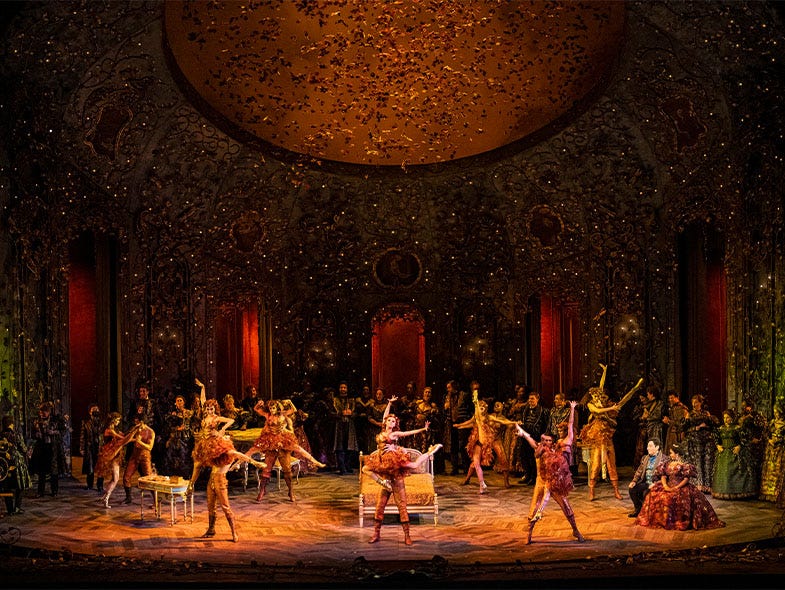
We finally had a do over of La Traviata this week, watching a lush production, styled like a Renaissance painting with lavish turquoise and gold rooms, and an exhilarating performance by Rose Feola as Violetta, the courtesan courted by an excellent Liparit Avetisyan as Alfredo, who is a dead ringer, for Mayor Mamdani, which added a bit of frisson to the evening. This time, the three hours passed in a flash. Before we knew it we were at Violetta’s last words, moments after she reunited with her lover.
How strange!
My pain has stopped.
It's strange - I feel alive.
Ah!  I shall live - o joy!
And then she dies and the opera ends.
I love the way opera glorifies our outsized emotions, filling a huge theater with love and loss and hope and despair, hurling it, in fact, to the rafters. As we admire the stupendous talents of its performers and designers, our own deepest emotions bubble and steam and spill over and out of us, offering temporary relief. Violetta’s determination to seek pleasure even as her suffering intensifies is inspiring. Her giving nature, even as a narrow minded society wrongly assumes the worst of her, shines through. Despite illness, financial ruin and an unfairly squandered love, Violetta lives until her last breath, her last emotion is one of ecstatic happiness. What is art but our attempt to express what we cannot bear to say in normal conversation, to enter the mystery of why we feel as we do? In honor of all our deep feelings, here is a Shakespeare’s Sonnet # 29 with video from my walk in Shakespeare’s Garden in Central Park this week.